What the Evidence Says About Green Space and Mental Health
Healthy Landscapes Ontario | October 8, 2025

Twenty minutes. That is the amount of time researchers at the University of Michigan found it takes for a walk in a natural setting to begin lowering cortisol, the hormone most closely tied to chronic stress. Not an hour-long forest retreat or a weekend at a provincial park. Twenty minutes in a neighbourhood green space, sitting or walking, and the body starts to respond.
This is one of the more practical findings in a field that has grown significantly over the past decade. The relationship between green space and mental health is no longer theoretical or anecdotal. It is backed by meta-analyses, longitudinal cohort studies, and clinical trials across multiple countries. The question has shifted from "does nature help?" to "how much, for whom, and what kind?"
The Weight of the Evidence
More than 100 peer-reviewed studies have now documented the stress-reduction benefits of time spent in green areas. A 2023 meta-analysis published in Environmental Research examined 57 studies and found consistent reductions in both anxiety and depression symptoms among people with regular green space exposure, with effect sizes comparable to some first-line treatments.
The mechanisms are not mysterious. Natural environments tend to lower heart rate and blood pressure. They reduce rumination, the repetitive negative thinking pattern strongly associated with depression. They encourage physical activity, even when that is not the stated purpose of the visit. And they create opportunities for social interaction that, unlike many indoor social settings, carry relatively low pressure.
One of the more striking data points comes from a Danish cohort study of nearly one million people. Children who grew up with the least access to green space had a 15 to 55 percent higher risk of developing psychiatric disorders in adulthood, depending on the specific condition. That range is wide, but the direction of the finding was consistent across diagnoses and held up after controlling for income, urbanization, and family history.
Ontario's Emerging Response
Ontario has started to pay attention. In 2021, the national PaRx nature prescription program expanded into the province with endorsement from the Ontario College of Family Physicians. The premise is straightforward: licensed healthcare providers can prescribe time outdoors, typically two hours per week, as a recognized part of treatment plans for anxiety, depression, and stress-related conditions.
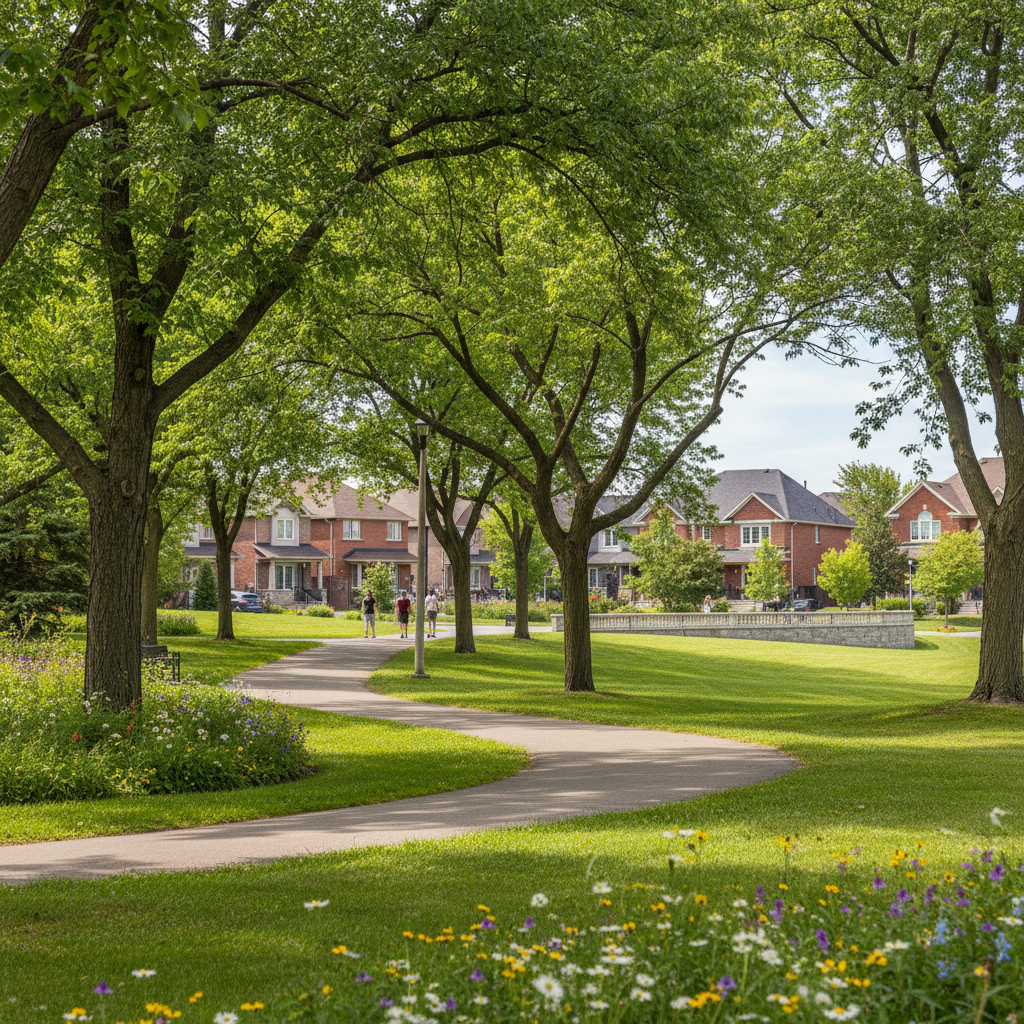
Neighbourhood parks, even modest ones, consistently show measurable mental health benefits for nearby residents.
Over 13,000 healthcare professionals across Canada have registered with PaRx since its launch. In Ontario, partnerships with the Toronto and Region Conservation Authority give prescribers access to free passes for conservation areas, removing one of the barriers (cost) that can make "go spend time in nature" feel hollow as advice.
This matters because the research on green space and community wellbeing consistently shows that the benefits are not evenly distributed. A 2024 systematic review in Humanities and Social Sciences Communications found that the mental health effects of neighbourhood green space were most pronounced among disadvantaged groups, including low-income residents, racial minorities, and people living alone. These are also the groups least likely to have quality green space nearby.
The Dose Question
Researchers at the University of Exeter made headlines with a finding from a study of 20,000 people: spending at least 120 minutes per week in natural environments was associated with significantly higher self-reported health and wellbeing. Below that threshold, the association largely disappeared.
But the 120-minute figure is a weekly total, not a single session. Shorter exposures delivered in intervals, a 20-minute walk here, a lunch break in a park there, appeared to produce cumulative benefits. For people who cannot set aside a full Saturday morning for a hike, this is useful information. It suggests that the neighbourhood park you pass on the way to the grocery store is not trivial. It is doing something.
People who used natural environments for physical activity at least once per week had roughly half the risk of poor mental health compared to those who did not, according to a Scottish health survey analysis. Each additional weekly session reduced the risk by a further six percent.
What This Means for Ontario Communities
The policy implications are becoming harder to ignore. If green space access is a determinant of mental health, then the distribution of parks and natural areas is a mental health equity issue. Ontario communities that are investing in new green space projects or improving access to existing natural areas are, whether they frame it this way or not, investing in mental health infrastructure.
That framing also changes the cost-benefit calculation. The Canadian Mental Health Association estimates the economic burden of mental illness in Ontario at over $50 billion annually. Even modest reductions in population-level anxiety and depression, the kind that a well-maintained network of neighbourhood green spaces can deliver, begin to look like a serious return on investment.
None of this means green space is a substitute for clinical care. But the evidence now suggests it is a meaningful complement, available at low cost, with no prescription side effects, and with benefits that scale with the population. For a province where access to trees and green space varies sharply by neighbourhood income, the research points in a clear direction: more green space, distributed more equitably, in the places where people actually live.