Parks, Play, and Family-Friendly Community Design
Healthy Landscapes Ontario | November 20, 2025
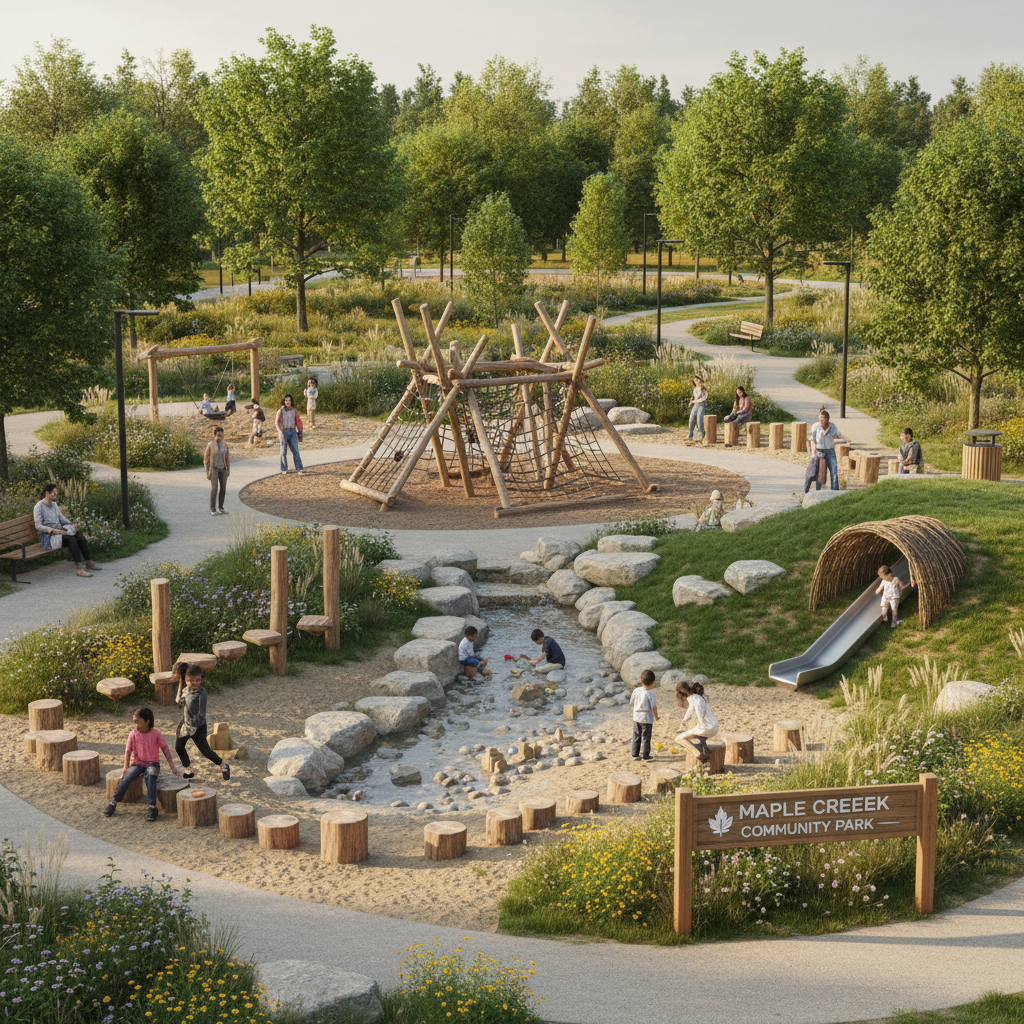
Thoughtfully designed parks serve multiple generations at once, keeping families outdoors longer and more often.
In the standard Ontario subdivision, a park is a flat rectangle of mowed grass with a swing set, a plastic climbing structure, and a bench or two near the parking area. It meets the municipality's parkland dedication requirement. It checks the box. And by mid-afternoon on most days, it sits empty.
That pattern is familiar to anyone who has spent time in suburban Ontario. Parks that look adequate on a planning map often fail in practice because they do not give people enough reasons to come, enough comfort to stay, or enough variety to return. They are designed to a minimum standard rather than to a community need.
But a number of Ontario municipalities are moving beyond minimum standards. They are redesigning parks as genuine neighbourhood centres, places where families spend entire afternoons, where parents run into neighbours, where teenagers have space that feels like theirs, and where older adults can sit comfortably and watch the activity around them. The design principles are not complicated, but they require a shift in how parks departments think about what a park is for.
The Problem with Standard Park Design
Most Ontario parks built in the past 40 years follow a formula driven by liability concerns, maintenance efficiency, and equipment catalogues. The playground equipment is chosen from a manufacturer's standard line. It is installed on a rectangular pad of engineered wood fibre or rubber surfacing. The surrounding area is turf grass, maintained on a mowing schedule. Trees, if present, are young and provide little shade.
This formula produces parks that are usable but not inviting. The play equipment is designed for children aged 5 to 12, which means toddlers and teenagers have nothing to do. Parents stand at the edge of the rubber pad watching their children, with nowhere comfortable to sit. There is no shade, no water, and no food. Visits are short because there is no reason to linger.
The result is that many Ontario families drive past their local park to reach a regional destination with more to offer. The neighbourhood park, which should be the most-used public space within walking distance of home, becomes the least attractive option.
What Family-Centred Design Looks Like
The parks that draw families consistently share several design features that go beyond standard equipment. They offer shade, seating, varied terrain, and activities for multiple age groups. They are designed for lingering rather than just visiting.
Sunnyside Park in Waterloo underwent a major redesign in 2021 that illustrates the approach. The previous park had a standard play structure on a flat site with no shade. The redesign added a nature-based play area with boulders, logs, sand, and a small water play channel alongside the traditional equipment. Mature trees were preserved and supplemented with new plantings. Seating was distributed throughout the park rather than concentrated at the edges, with benches, picnic tables, and informal stone seating walls placed where parents could watch children while sitting in shade.
The redesign also added a small pavilion with a washroom, which sounds mundane but is transformative for families with young children. A park without a washroom has a built-in time limit. A park with one allows families to stay for hours.
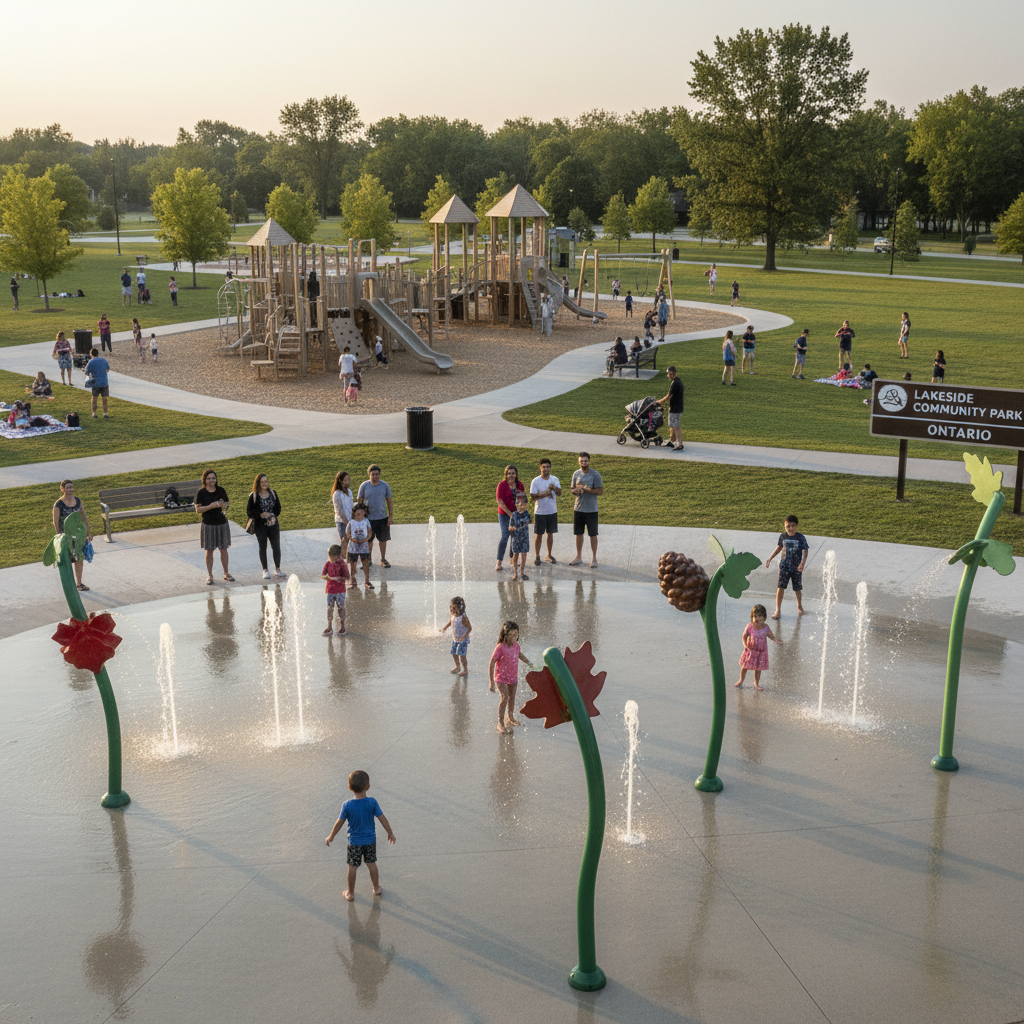
Multi-generational design means toddlers, older children, parents, and grandparents all have reasons to use the same space.
Usage at Sunnyside Park increased significantly after the redesign. Parks staff reported that the average visit length roughly doubled, and the park attracted users from a wider geographic area than before. The nature play area, in particular, drew children who returned repeatedly because the play experience was different each time, unlike a fixed climbing structure that offers the same movements on every visit.
Natural Play and Risky Play
Ontario parks are increasingly incorporating natural play elements: logs for balancing, boulders for climbing, shallow streams for splashing, hills for rolling, and loose materials like sand, gravel, and sticks for building. These elements draw on research showing that children benefit from play that involves some degree of manageable risk, physical challenge, and open-ended creativity.
The concept is sometimes called "risky play," though the actual risks are modest. A child climbing a boulder or balancing on a log faces the possibility of a minor fall, which is a fundamentally different order of risk than the traffic-related dangers that have driven children indoors in the first place. The evidence suggests that children who engage in this kind of play develop better motor skills, spatial awareness, and risk assessment abilities than children whose play is confined to fixed, standardized equipment.
Municipalities in Ontario that have added natural play elements report strong community response. In Cambridge, a naturalized play area at Hespeler Mill Pond Park became one of the most popular features in the city's entire park system within its first year. The combination of water access, natural materials, and varied terrain created a play environment that children used differently depending on the season, returning to the same space but finding new activities each time.
The liability concerns that once discouraged natural play in Ontario have been largely addressed through updated CSA standards for playgrounds, which now include provisions for natural play environments. Municipalities can design and build these spaces within the existing regulatory framework, provided the designs are reviewed by qualified playground safety inspectors.
Parks as Social Infrastructure
The most significant benefit of well-designed family parks may be social rather than physical. Parks where people stay for extended periods become places where neighbours meet, where friendships form between parents of young children, and where the casual social interactions that build community trust happen naturally.
This social function is particularly important in newer Ontario subdivisions, where many residents have moved from elsewhere and do not yet have established local networks. A park that draws families regularly becomes a shared gathering place that accelerates the process of community formation. The alternative, a neighbourhood where everyone retreats to their backyard or drives to dispersed activities - produces isolation that is increasingly recognized as a public health concern.
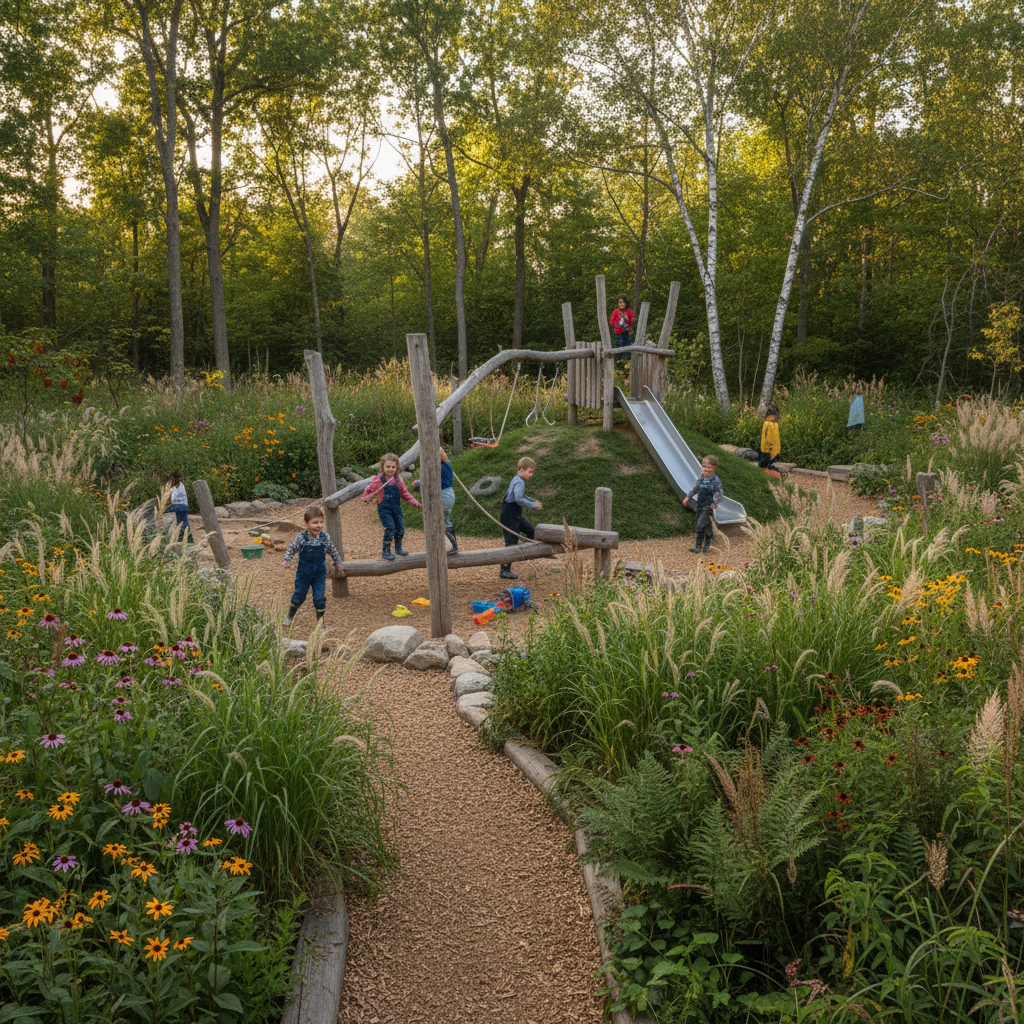
Nature-integrated playgrounds offer open-ended play that keeps children engaged across seasons and developmental stages.
Research from the University of Waterloo's School of Planning found that parents who regularly use neighbourhood parks report stronger sense of community belonging and larger local social networks than parents who do not. The relationship is correlational rather than strictly causal, but the pattern is consistent: parks that work as social spaces produce measurable social outcomes.
Design for All Seasons
An Ontario park that only works from June to September is underperforming for eight months of the year. Family-friendly park design increasingly considers year-round use. This means features like toboggan hills (which double as terrain for summer play), sheltered seating areas that block winter wind, lighting that makes after-school visits possible during short winter days, and surfaces that remain usable when wet or lightly covered in snow.
Some municipalities are adding winter-specific features to their parks. Guelph has piloted outdoor skating paths in selected parks, using refrigerated surfaces that maintain ice reliably through the winter. Kingston has incorporated cross-country ski and snowshoe trail connections into its park network. These additions extend the useful season of parks and reinforce the idea that outdoor activity is a year-round practice rather than a summer indulgence.
The trail connections into and through parks also matter for year-round use. A park that can be reached by a maintained, well-lit trail is accessible in December. A park that can only be reached by crossing an unplowed field or an icy parking lot is effectively closed for the winter.
Lessons for Ontario Communities
The parks that work best for families in Ontario share a few consistent features. They provide shade through mature trees or structures. They include seating that is comfortable, shaded, and distributed throughout the park rather than clustered at the entrance. They offer play experiences for multiple age groups, including natural play elements that encourage creativity and return visits. They have washrooms. And they connect to the surrounding neighbourhood through safe, walkable routes rather than requiring a car to reach.
These are not expensive or complicated features. They require thoughtful design rather than large budgets. The cost difference between a standard park and a well-designed family park is modest compared to the difference in how much each one gets used. Ontario's neighbourhoods deserve parks that function as genuine community gathering places, not just as equipment pads surrounded by mowed grass.