Rain Gardens and Community Stormwater Solutions
Healthy Landscapes Ontario | December 20, 2025
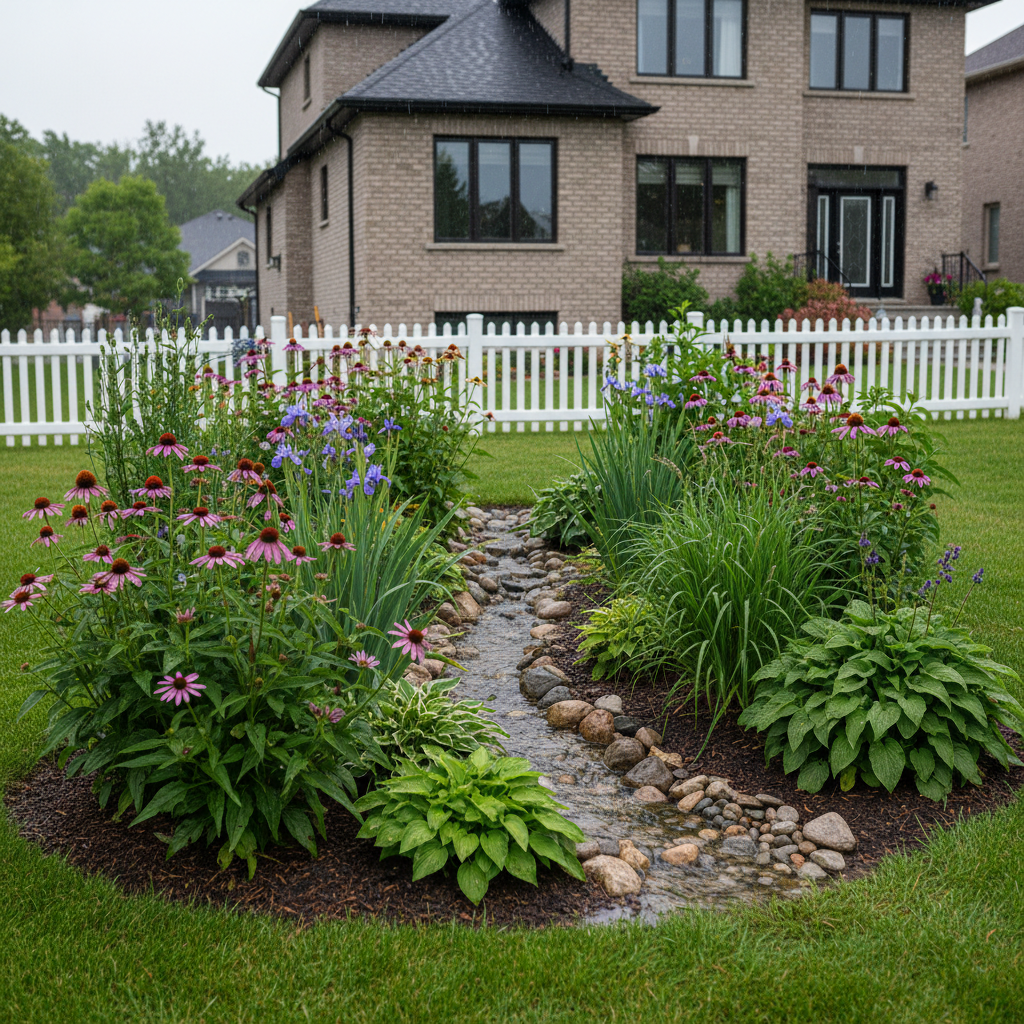
Rain gardens capture and filter stormwater at the surface, reducing pressure on underground pipe systems while adding beauty to streetscapes.
When heavy rain hits a typical Ontario city, the water has nowhere to go but down. It runs off roofs, driveways, roads, and parking lots into storm drains, which funnel it through underground pipes to the nearest creek or river. Along the way, it picks up oil, road salt, fertilizer, and sediment. It arrives at the waterway fast, dirty, and in volumes that erode banks and overwhelm ecosystems. During the biggest storms, it backs up into basements.
This system was designed for a different era. Ontario's stormwater infrastructure was built assuming a certain amount of impervious surface, a certain rainfall intensity, and a certain capacity in the receiving waterways. All three of those assumptions are now outdated. Urban areas have more pavement than ever. Climate change is producing more intense rainfall events. And the creeks and rivers receiving all that runoff are already stressed.
Rain gardens and other green stormwater infrastructure offer a different approach. Instead of rushing water underground as fast as possible, they slow it down, spread it out, and let the ground absorb it. The concept is simple. The implementation, as several Ontario communities are discovering, requires a shift in how we think about the relationship between water and land.
What Rain Gardens Actually Do
A rain garden is a shallow, planted depression that collects stormwater from surrounding surfaces and allows it to soak into the ground over 24 to 48 hours. The soil mix is engineered for drainage, typically a blend of sand, compost, and native topsoil. The plants are chosen for their ability to tolerate both wet and dry conditions, since the garden alternates between inundation and drought depending on rainfall.
The filtration process is surprisingly effective. As water percolates through the soil, pollutants are captured by plant roots, soil organisms, and physical filtering. Studies by the Credit Valley Conservation Authority have documented removal rates of 80 to 90 percent for suspended solids, 60 to 80 percent for phosphorus, and significant reductions in heavy metals and hydrocarbons. The water that eventually reaches the groundwater table or drains to the storm system is substantially cleaner than what went in.
Rain gardens also reduce the volume and speed of runoff. By absorbing water at the surface, they decrease the peak flow that reaches storm pipes and waterways during heavy rain. This reduction in peak flow is what prevents basement flooding and stream erosion. A single rain garden handles only a small area, but hundreds of them distributed across a neighbourhood can significantly reduce stormwater impacts at the watershed scale.
The Credit Valley Conservation Pilot
The Credit Valley Conservation Authority, based in Mississauga, has been one of Ontario's leaders in promoting and installing green stormwater infrastructure. Starting around 2012, the organization launched a series of pilot projects in partnership with municipalities across the Credit River watershed, demonstrating rain gardens, permeable pavement, and bioswales in real-world settings.

Permeable paving allows rainwater to pass through the surface into a stone reservoir below, reducing runoff from parking areas and driveways.
One of the most visible projects was the retrofit of Elm Drive, a residential street in central Mississauga. The project replaced conventional curbs and gutters with a series of bioswales and rain gardens that capture street runoff before it enters the storm sewer. The plantings include native grasses, sedges, and wildflowers that handle the fluctuating water levels while providing habitat for pollinators and other insects.
Monitoring data from the Elm Drive project showed that the green infrastructure reduced runoff volume by approximately 40 percent and reduced peak flow rates by over 50 percent during moderate storms. During the largest storms, the system still overflows into the conventional storm sewer, but the conventional system handles a much smaller volume than it would without the green infrastructure in place.
The project also demonstrated something that engineers and planners had not fully anticipated: residents loved it. The rain gardens transformed a standard suburban street into something noticeably more attractive. Neighbours who were initially skeptical about the construction disruption became advocates for the approach once the plantings established. Several residents installed their own rain gardens on private property after seeing the street-level installations.
Scaling Up in Kitchener
The City of Kitchener has taken green stormwater infrastructure from pilot projects to municipal standard practice. The city's stormwater management program now requires new developments and major redevelopments to incorporate on-site stormwater management using green infrastructure techniques. This means rain gardens, permeable pavement, green roofs, and infiltration galleries are becoming routine components of site plans rather than experimental add-ons.
Kitchener also created a stormwater utility, funded by a fee based on each property's impervious surface area, that provides stable funding for stormwater infrastructure investments. Property owners can reduce their fee by installing rain gardens or other features that reduce their property's runoff contribution. This financial incentive has driven significant private-sector adoption of green infrastructure, particularly among commercial property owners with large parking areas.
The stormwater utility model has been adopted by several other Ontario municipalities, including Mississauga, London, and Markham. The common feature is a dedicated, predictable revenue stream for stormwater management that is not subject to the annual budget competition with other municipal priorities. This funding stability is essential for the long-term maintenance that green infrastructure requires.
Residential Rain Gardens
While municipal-scale projects get the most attention, residential rain gardens may ultimately have the largest collective impact. Ontario's residential properties represent an enormous area of impervious surface in the form of roofs, driveways, and patios. Directing runoff from even a portion of this surface area into rain gardens would significantly reduce the stormwater burden on municipal systems.
Several Ontario conservation authorities offer residential rain garden programs that provide design assistance, native plant materials, and sometimes financial subsidies to homeowners who install rain gardens on their property. The Toronto and Region Conservation Authority's Sustainable Neighbourhood Retrofit Action Plan has supported hundreds of residential rain garden installations across the Greater Toronto Area.
A typical residential rain garden in Ontario handles runoff from a section of roof, capturing water via a downspout disconnection that directs flow to the planted depression rather than to the storm sewer. The garden is sized to absorb the runoff from a moderate rainfall event, typically about 25 millimetres, which covers the vast majority of rain events in southern Ontario. Larger storms overflow to the existing drainage system.

Neighbourhood stormwater retrofits transform underused spaces into productive, attractive rain gardens within a single growing season.
The plants used in Ontario rain gardens are predominantly native species adapted to the province's climate and soil conditions. Common choices include cardinal flower, blue flag iris, switchgrass, and Joe-Pye weed, which thrive in the alternating wet and dry conditions that rain gardens create. These plantings provide pollinator habitat and visual interest while performing the essential function of managing water at the surface.
Challenges and Limitations
Green stormwater infrastructure is not a complete replacement for conventional systems. Ontario's heaviest storms produce volumes that exceed the capacity of surface-based systems, and the conventional pipe network remains necessary as the backbone of stormwater management. Green infrastructure works best as a complement that handles the frequent, moderate storms that do the most cumulative damage to water quality and stream health.
Winter performance is a common concern in Ontario. Rain gardens do not function when the ground is frozen, which in southern Ontario typically means December through March. During this period, conventional drainage handles all runoff. However, the largest and most damaging rainfall events in Ontario occur during the warm months, so the seasonal limitation does not eliminate the benefits.
Maintenance is the most persistent challenge. Rain gardens require weeding, occasional soil amendment, plant replacement, and periodic inspection of inlet and outlet structures. This maintenance is not complicated, but it needs to happen consistently. Municipal rain gardens that are maintained by parks or public works departments have generally performed well. Residential rain gardens, which depend on homeowner attention, have more variable long-term performance.
Lessons for Ontario Communities
The communities leading green stormwater infrastructure in Ontario have discovered that the technology works, the costs are competitive with conventional approaches, and public acceptance is strong once people see the results. The barriers are primarily institutional: engineering standards that default to pipes, procurement processes that favour conventional contractors, and maintenance responsibilities that fall between departmental mandates.
Overcoming these barriers requires sustained leadership from municipal staff, elected officials, and conservation authorities who are willing to champion a different approach. The evidence from Kitchener, Mississauga, and other Ontario communities shows that the shift is achievable and that the benefits extend well beyond stormwater management to include neighbourhood beautification, habitat creation, and community engagement with the landscape.