Stormwater Management for Residential Properties
Healthy Landscapes Ontario | January 25, 2026
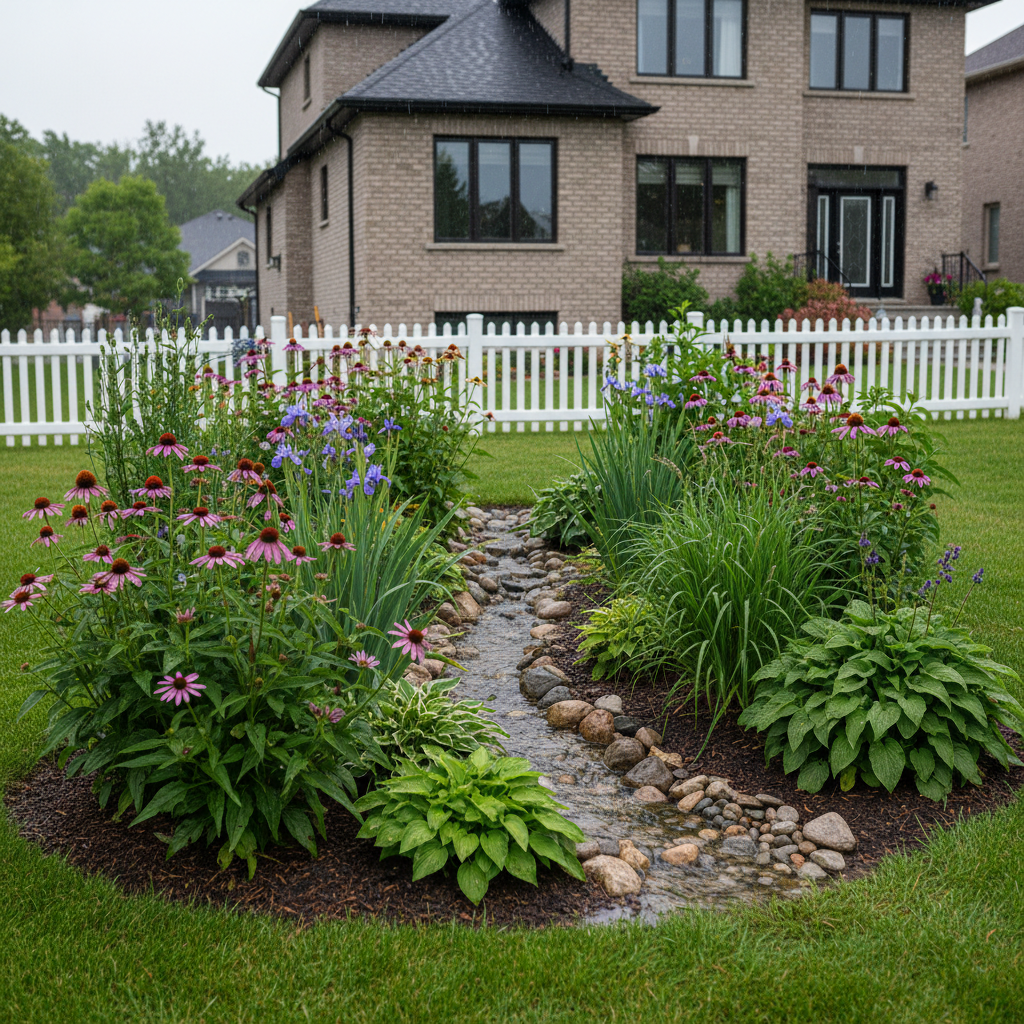
A well-designed rain garden captures roof runoff and allows it to soak into the ground rather than overwhelming storm drains or flowing toward your foundation.
Every time it rains, the water that falls on your roof, driveway, patio, and walkways has to go somewhere. On a natural landscape, most rainfall soaks into the soil. On a typical Ontario residential property, where roofs and pavement cover 40 to 60 percent of the lot, most rain becomes runoff, flowing across hard surfaces, picking up pollutants, and rushing into storm drains, ditches, or neighbouring properties.
This runoff causes problems at every scale. At the property level, it can flood basements, erode gardens, and damage foundations. At the municipal level, it overwhelms aging storm sewer systems. At the watershed level, it degrades streams, rivers, and lakes with sediment, road salt, fertilizer, and other contaminants. The Ontario Stormwater Management Planning and Design Manual provides the technical framework that municipalities use to address these challenges.
The good news is that homeowners can make a significant difference. By managing stormwater on your own property, you protect your home, reduce pressure on municipal systems, and improve the health of local waterways. This guide covers the most practical and effective techniques for Ontario residential properties.
Understand Your Property's Water Flow
Before making any changes, spend time observing how water moves across your property during a rainstorm. Watch where roof water exits your downspouts. Notice where puddles form. See where water flows across your yard and where it leaves your property. This observation tells you where to focus your efforts.
Key questions to answer:
- Where do your downspouts discharge? Are they connected to the storm sewer or do they release water onto the ground?
- Does water pool near your foundation or in low spots on your property?
- Does your property slope toward your house, toward your neighbour's property, or toward the street?
- How much of your lot is covered by impervious surfaces (roof, driveway, walkways, patio)?
Disconnect Your Downspouts
If your downspouts are connected to the municipal storm sewer (common in older Ontario neighbourhoods), disconnecting them and directing roof water onto your lawn or into a rain garden is one of the simplest and most effective steps you can take. Many Ontario municipalities now require downspout disconnection, and some offer rebates or free assistance.
When disconnecting, ensure water is directed at least 1.5 to 2 metres away from your foundation and does not flow toward neighbouring properties. A simple splash pad or extension at the base of the downspout can direct water toward a garden bed or permeable area.
Build a Rain Garden
A rain garden is a shallow, planted depression designed to collect and absorb stormwater. It is the single most effective residential stormwater technique, combining water management with beautiful, habitat-rich plantings.
Here is how to build one:
- Choose a location: At least 3 metres from your foundation, in a spot where water naturally collects or can be directed from a downspout. Avoid areas over septic systems or utility lines.
- Size it: Aim for 10 to 20 percent of the roof area draining to it. For a 50-square-metre roof section, a 5 to 10-square-metre rain garden works well.
- Excavate: Dig to a depth of 15 to 20 centimetres with a flat bottom. Create a berm on the downslope side to hold water.
- Amend the soil: If your soil is heavy clay, mix in compost and coarse sand to improve infiltration. A good rain garden soil mix is roughly 60 percent sand, 20 percent compost, and 20 percent existing topsoil.
- Plant: Use native plants that tolerate both wet and dry conditions. Swamp milkweed, blue flag iris, cardinal flower, switchgrass, and black-eyed Susan are reliable choices for Ontario rain gardens.
- Mulch: Apply 5 to 8 centimetres of shredded hardwood bark mulch to suppress weeds and protect soil.
A properly built rain garden should drain within 24 to 48 hours after a storm. If water stands longer than that, the soil needs more amendment to improve drainage.
Use Permeable Surfaces

Permeable pavers allow rainfall to drain through gaps between units into a gravel reservoir, eliminating runoff from driveways and patios.
Replacing conventional concrete or asphalt with permeable alternatives is one of the most impactful changes you can make. Options include:
- Permeable interlocking pavers: Concrete or stone units with open joints filled with gravel that allow water to pass through. Suitable for driveways, patios, and walkways.
- Gravel or crushed stone: The simplest permeable surface. Works well for lightly used areas, parking pads, and garden paths.
- Grass pavers: Grid systems that support vehicle weight while allowing grass to grow through. Good for occasional-use parking areas.
- Porous asphalt or concrete: These specialized materials allow water to pass directly through the surface. More expensive but effective for larger areas.
All permeable surfaces require a gravel base reservoir (typically 30 to 45 centimetres deep) beneath the surface to temporarily store water as it infiltrates into the soil below. In Ontario, the base depth should account for spring snowmelt volumes and local frost depth.
Improve Your Soil
Compacted soil is a hidden cause of residential stormwater problems. When soil is compacted by construction, foot traffic, or heavy equipment, it loses its ability to absorb water and essentially acts like pavement. This is especially common on newer Ontario properties where topsoil was stripped during construction and replaced with a thin layer of sod over compacted fill.
To improve soil infiltration:
- Aerate compacted lawn areas and top-dress with compost.
- Add organic mulch to garden beds annually.
- Plant deep-rooted native perennials and grasses that break up compacted soil over time.
- Minimize foot traffic and machinery on saturated soil.
Additional Techniques
Rain barrels: A 200-litre rain barrel captures roof water for later use in the garden. It will not handle a major storm on its own, but it reduces potable water use and provides some stormwater benefit when combined with other techniques.
Dry wells: An underground gravel-filled pit that receives downspout water and allows it to infiltrate slowly. Useful where surface space for a rain garden is limited.
French drains: A perforated pipe in a gravel-filled trench that intercepts and redirects subsurface water away from foundations and low spots.
Grading improvements: Simply adjusting the slope of your yard so that surface water flows away from your foundation and toward a rain garden or permeable area can prevent the most common residential water problems.
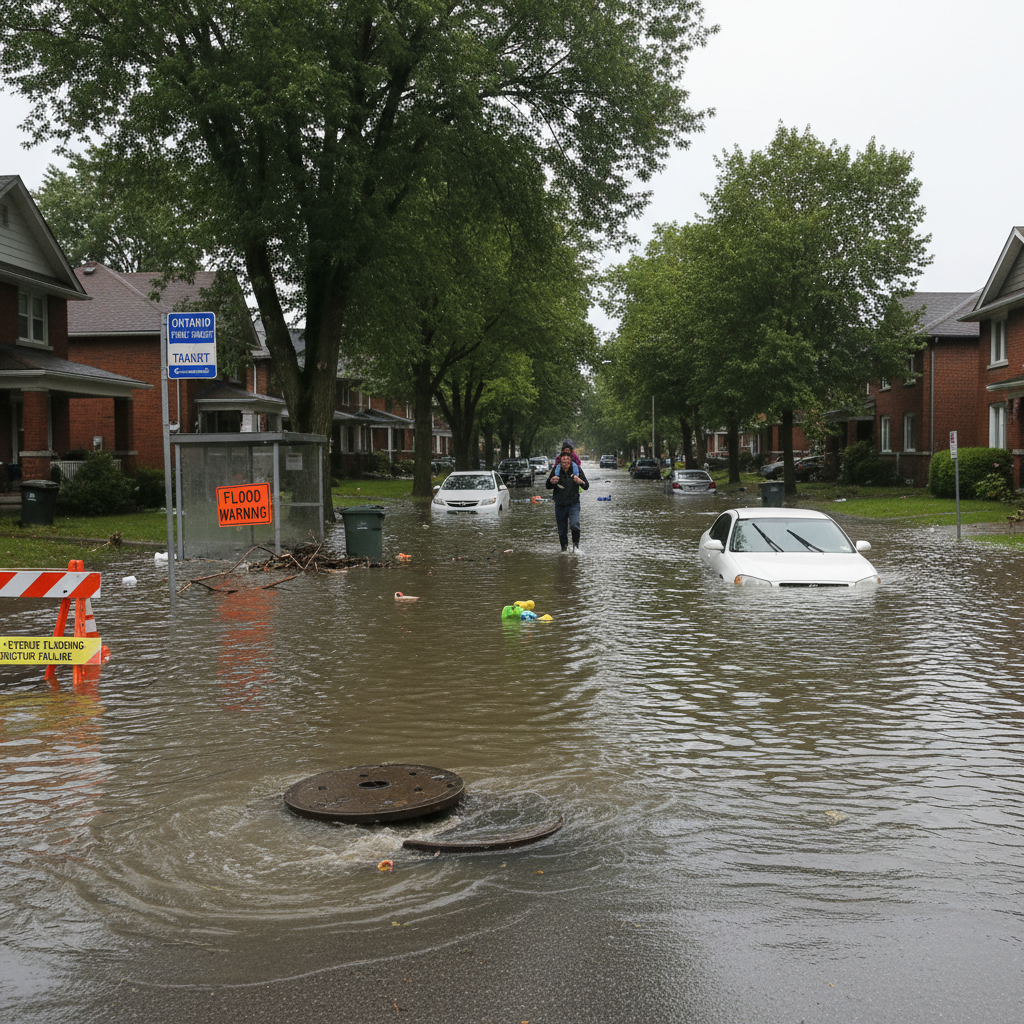
Intense rainfall events are becoming more frequent in Ontario, making property-level stormwater management increasingly important for protecting homes and infrastructure.
Municipal Support and Rebates
Many Ontario municipalities offer incentives for residential stormwater management. Toronto's Eco-Roof Incentive Program, Mississauga's stormwater charge credit program, and similar programs in Kitchener, Guelph, and other cities provide financial support for homeowners who reduce their runoff. Check with your municipality's stormwater or engineering department to learn what programs are available in your area.
Your local conservation authority is another excellent resource. Many offer free consultations, workshops, and planting guides specifically for residential green infrastructure projects.
Frequently Asked Questions
What is the most effective residential stormwater management technique?
Rain gardens are generally the most effective single technique for residential properties. A properly sized rain garden can absorb 30 to 40 percent more water than an equivalent area of lawn. Combining a rain garden with downspout disconnection, permeable surfaces, and healthy soil creates a system that manages the majority of rainfall events on your property.
Do I need a permit to install a rain garden in Ontario?
In most Ontario municipalities, a simple rain garden on your own property does not require a permit. However, if your project involves altering grading near property lines, connecting to municipal infrastructure, or working within a floodplain, you should check with your municipality and local conservation authority. Some municipalities offer guidance or even rebates for residential stormwater projects.
How big should a rain garden be?
A general guideline is to size a rain garden at 10 to 20 percent of the impervious area draining into it. For a typical house roof of 100 square metres, a rain garden of 10 to 20 square metres is appropriate. The garden should be 15 to 20 centimetres deep with a flat bottom to allow water to pool and infiltrate evenly.
Will a rain barrel make a meaningful difference?
A single 200-litre rain barrel fills up quickly during a significant storm and can only capture a small fraction of roof runoff. Rain barrels are most useful for collecting water for garden irrigation between storms. For meaningful stormwater reduction, combine a rain barrel with other techniques like rain gardens, permeable surfaces, and soil improvement.